
Metal Roof Coating FAQ · Shelbyville, KY
Shelbyville Metal Roof Coating Questions
Answers to the questions owners ask most about coating commercial metal roofs in Shelbyville, Shelby County, and the towns around them.
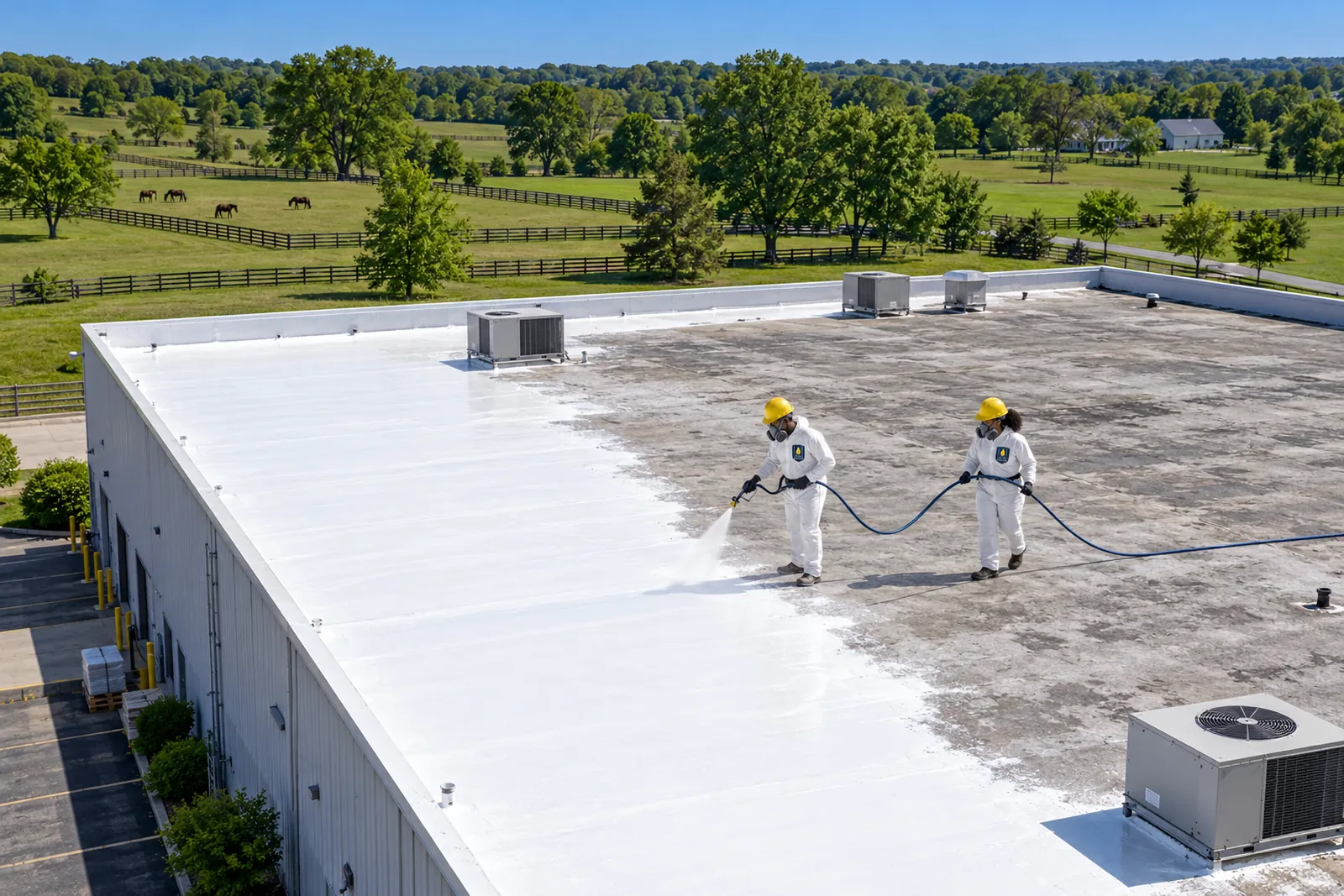
- 45 Questions In 9 Topics
- Permit Answers Town By Town
- Rust, Fasteners, And Seams
Shelbyville Metal Roof Coating Questions By Topic
Metal roof coating is a liquid-applied membrane, most often silicone or acrylic, sprayed or rolled over steel roof panels to seal fasteners, seams and laps and slow rust. Shelbyville Metal Roof Coating coats commercial metal roofs and installs silicone, acrylic, spray foam and shingle roof coatings in Shelbyville, Shelby County, Kentucky, and surrounding towns from La Grange to Carrollton.
Metal Roof Coating Basics
What does a metal roof coating actually do?
A metal roof coating forms a continuous rubbery film over the panels that seals screw heads, side laps and end laps while shielding the factory paint from sunlight and moisture. Once cured, it becomes a new waterproof surface over steel that still carries its load.
On a commercial panel roof, the coating system covers:
- fastener heads and their rubber washers;
- horizontal end laps, where wind can push water uphill;
- ridge caps, eave trim and rake trim;
- penetrations such as vent stacks and exhaust curbs.
The steel still handles structure while the coating handles weather. That split is why panel condition gets checked before any coating is chosen.
Which commercial metal roofs are good candidates for coating?
Metal roofs make good coating candidates when the panels are firmly attached, the rust is mostly on the surface and the space under the roof stays dry. Warehouses, shop buildings, horse barns, church fellowship halls and strip-center canopies in Shelby County often fit that description.
Signs that point toward coating:
- Chalky or faded paint with intact steel underneath.
- Leaks traced to screw washers or lap seams instead of holes in the panels.
- Rust bloom around fasteners that brushes off to firm metal.
Rust-through holes across many panels, panels lifting in wind and purlins sagging between frames point the other way. Those conditions call for panel or structural work first.
What shortens the life of a coating on a metal roof?
Thin film, standing water and skipped upkeep are the three things that wear out a metal roof coating early. Each one shows up in a predictable place.
- Thin film appears first on panel ribs and ridge caps, where wet coating drains off the high points.
- Standing water collects at low eaves, behind rooftop units and in valleys where two roof planes meet.
- Neglect shows as cracked sealant at skylight panels and pipe boots that nobody resealed.
Applicators measure wet film thickness with a gauge and add passes on ribs and laps. A yearly walk catches worn spots while a small touch-up still fixes them.
Does a white coating keep a metal building cooler?
A white or light-colored coating keeps a metal roof cooler because it reflects more sunlight and sheds absorbed heat faster. The U.S. Department of Energy rates roof coolness by solar reflectance and thermal emittance, each scored from 0 to 1, with higher numbers running cooler.
The Cool Roof Rating Council directory lists rated roof products, and ENERGY STAR points owners to it as well. DOE guidance adds two limits:
- Dirt and weathering lower reflectance over time, so aged ratings matter more than new ones.
- Heated buildings lose some free solar warmth in winter, though in mixed climates DOE says that penalty is usually smaller than the summer savings.
Rust, Fasteners and Seams
How is rust treated before a metal roof is coated?
Every rusted area is cleaned to solid steel and primed with a rust-inhibiting product before the coating is applied. Coating over loose rust traps moisture and lets corrosion keep spreading under the film.
| Rust stage | What it looks like | Usual treatment |
|---|---|---|
| Rust bloom | Orange haze around screws and laps | Wire brush, clean, prime |
| Red rust scale | Flaking, rough patches | Power-tool cleaning, then primer |
| White rust | Chalky white powder on galvanized steel | Clean off, use a primer approved for zinc |
| Rust-through | Pinholes or open holes | Patch or replace the panel |
Primer choice follows the coating maker's instructions for that steel and that rust condition.
What happens to the screws and washers on an exposed-fastener roof?
Every screw on an exposed-fastener roof gets checked, tightened or replaced, then sealed under the coating, because dried-out washers are among the most common leak points on R-panel roofs. Rubber washers harden in sunlight, and panel movement from heat and cold slowly backs screws out of the purlins.
Fastener work runs in this order:
- Loose screws are driven snug against the washer.
- Stripped holes get an oversize replacement screw.
- Heads are wire-brushed and wiped clean.
- Crews cap each one with mastic or brushed-on sealant before the base coat.
Overdriven screws that crushed their washers get replaced as well.
How are seams, side laps and end laps sealed?
Seams and laps are sealed with a reinforced detail, usually polyester fabric set into a brushed coat of mastic or base coat, before the full roof gets coated. That extra layer bridges the small gaps that open and close as panels expand in summer heat.
End laps get the most attention. Water runs downhill across them, and wind can drive it uphill under the top panel. Side laps along the ribs get a narrower stripe.
Ridge caps, eave closures and the joint where panels meet a wall flashing receive the same fabric treatment. Once the seam work cures, crews roll or spray the base coat over it and the open panel field.
Can standing seam roofs be coated the same way as R-panel roofs?
Standing seam and exposed-fastener R-panel roofs both take coatings, but their prep differs because one hides its fasteners in clips and the other puts every screw on the surface.
| Detail | Standing seam | Exposed-fastener R-panel |
|---|---|---|
| Fasteners | Concealed clips under the seam | Hundreds of screws through the panel face |
| Main leak points | Seam ends, panel ends at the ridge, penetrations | Washers, end laps, side laps |
| Seam prep | Clean and seal seam ends, confirm seams stay locked | Fabric over end laps, stripe side laps |
| Movement | Panels float on clips | Panels pinned at every screw |
On standing seam roofs, coating at the seams has to leave panels free to slide on their clips. Coating built up thick enough to lock a seam can crack along the rib.
Do skylight panels, ridge caps and gutters get coated too?
Ridge caps, trim and gutters usually get coated along with the panels, while translucent skylight panels get replaced, masked or covered based on whether the owner still wants the daylight.
- Ridge caps: fasteners and closures sealed, then coated across the cap.
- Skylight panels: faded fiberglass that cracks in hail is often swapped for steel or new translucent panels before coating.
- Gutters: rusted seams resealed, outlets cleared, interior coated where the steel remains firm.
- Curbs and flashing: coated up the curb sides to the counterflashing.
A roof walk sorts each item into coat, repair or replace.
Choosing a Coating
Silicone or acrylic: which is better over a metal roof?
Silicone holds up better where water sits on the roof after rain, while acrylic fits steeper, fast-draining metal roofs and stays cleaner. Urethane adds a third option for impact and traffic.
| Point | Silicone | Acrylic | Urethane |
|---|---|---|---|
| Standing water | Resists ponding | Softens under long ponding | Resists ponding |
| Dirt pickup | Collects dirt, loses brightness | Stays cleaner | Moderate |
| Foot traffic and impact | Softer film | Moderate | Toughest film |
| Later recoats | Usually silicone again | Accepts acrylic recoats | Follows the maker's system |
Low-slope metal buildings with flat spots around rooftop units lean toward silicone. Steeper barns and canopy roofs that shed water fast often get acrylic.
When does urethane make sense on a metal roof?
Urethane coatings make sense on metal roofs that see heavy foot traffic, hail or impact, because the cured film is harder than silicone or acrylic. Roofs with frequent service trips to rooftop units, or with walk paths between a hatch and equipment, wear coatings unevenly, and urethane handles that wear.
Aromatic urethanes yellow and chalk in sunlight, so they go under a UV-stable top coat. Aliphatic urethanes hold up in sunlight on their own.
Some systems use urethane as a base coat over seams and fasteners, then silicone or acrylic as the finish. The coating maker's published system decides which layers go together.
Can spray foam go over a metal roof instead of a coating alone?
Spray foam can go over a metal roof when the owner wants added insulation and a thicker leak barrier, while a coating alone fits roofs that only need sealing. Closed-cell foam adds about R-6 per inch, according to U.S. Department of Energy Building America guidance.
| Point | Coating only | Spray foam plus coating |
|---|---|---|
| Thickness | Thin film | Inches of foam plus coating |
| Insulation | Little added | About R-6 per inch |
| Ribs and laps | Sealed, profile stays visible | Filled and covered |
| Condensation under panels | Unchanged | Reduced, as steel stays closer to indoor temperature |
| Curbs and gutters | Unchanged | Often need raising or extending |
Foam fits uninsulated shops and barns with dripping condensation. Coating alone fits insulated warehouses with leaky laps.
Can a coating go on the shingle roof of a commercial building?
Shingle roof coating works on some commercial asphalt-shingle roofs, such as strip centers, offices and churches, when the shingles lie flat and hold most of their granules. Brittle, curled or cupped shingles are poor candidates, since coating cracks along every lifted edge.
Before anything goes on, check:
- Shingle manufacturer terms, since a coating can affect shingle coverage.
- Coating maker approval for asphalt shingles specifically.
- Granule buildup in gutters and at downspout outlets.
- Attic ventilation at ridge vents and soffits.
Steep slopes also change how crews stage and walk the roof. Where those checks fail, replacing the shingles makes more sense than coating them.
Does a new coating have to match what is already on the roof?
New coating has to be compatible with whatever sits on the panels now, whether factory paint, an old acrylic, an old silicone or bare galvanized steel. Old silicone is the main troublemaker, since few products bond to it except more silicone. Chalky factory finishes and old acrylics often need a specific primer.
An adhesion test patch settles the question. Crews clean a few spots, apply the planned primer and coating, let them cure, then pull the film to see how well it grips.
Tests go on the worst areas, such as chalky panels on the south face and around exhaust curbs where grease collects.
Climate and Weather in Shelby County
How do Kentucky rain and freeze-thaw cycles affect coated metal roofs?
Heavy rain and repeated freezes hit coated metal roofs hardest at low eaves, clogged gutters and loose fasteners. The National Weather Service office in Louisville recorded 48.23 inches of precipitation at Louisville's airport in 2024, near its normal of about 48 inches, along with a low of 3°F on January 20.
Each freeze and thaw makes steel panels shrink and grow. That flexing loosens screws over time and opens hairline cracks in stiff, aged sealant at end laps. Elastomeric coatings stretch with the steel instead of splitting.
Gutters packed with leaves back water up under eave trim, where ice adds pressure in January.
What does hail do to a coated metal roof?
Hail dents steel panels and can split a coating at the dent, especially on aged film over thin-gauge panels. NWS Louisville's 2024 summary noted golf-ball-size hail in counties south of Louisville on May 8, and storms like that leave a familiar pattern on metal roofs.
After a hail event, look for:
- Round dents on panel flats and crushed rib tops.
- Cracked coating at the edges of dents.
- Broken or punctured skylight panels.
- Dented gutters and bent downspout heads.
Dents with intact coating are cosmetic. Cracked film gets cleaned and recoated over the spot, and punctured panels get replaced. Photos taken soon after the storm help with any insurance claim.
Is it too cold or humid in Shelby County to coat a metal roof?
Coating work in Shelby County fits best from late spring through early fall, when panel temperatures stay above the coating maker's minimum and dew burns off early. Metal roofs collect heavy dew because steel cools quickly at night.
Each work day is checked against:
- Surface temperature compared with the dew point.
- Rain chances during the cure window.
- Overnight lows for water-based acrylics, which need warmth to cure.
- Wind, which carries spray mist toward parked vehicles.
Silicone tolerates cooler, damper conditions than acrylic, so late-season jobs often shift to silicone. Frost lingering on shaded north-facing panels pushes start times later on fall mornings.
Prep, Application and Downtime
What prep work happens before coating a metal roof?
Prep starts with a roof inspection and ends with clean, primed, rust-free metal, and it takes more labor than the coating itself on most roofs.
- Inspect Your Roof for loose panels, rust-through and leak sources.
- Pressure-wash panels to remove chalk, dirt and bird droppings.
- Grind or brush rust and prime the bare spots.
- Tighten, replace and seal fasteners.
- Reinforce end laps, side laps and ridge caps with fabric.
- Mask skylight panels, vents and equipment that stay uncoated.
Washing with a cleaner the coating maker approves matters, because chalky factory paint left on the surface acts like a release agent. Panels dry fully before primer goes on.
How is the coating applied to the roof?
Crews apply metal roof coatings by airless spray or roller in one or two coats, after seams and fasteners are already detailed. Spray covers ribbed panels faster, while rollers give more control near property lines, parked cars and air intakes.
Film thickness is the number that matters. Applicators check wet mils with a notched gauge as they go and track gallons per section to confirm the full rate went down.
Ribs, laps and ridge caps get extra passes since coating drains off high points. On two-coat systems, the second coat often goes on in a contrasting color to expose any missed spots in the first.
Can my business stay open while the metal roof is coated?
Most businesses keep operating during a metal roof coating because the work happens entirely on top of the panels with no tear-off. Inside, the main concern is odor from solvent-based products near rooftop air intakes.
Planning points:
- Intakes and exhaust fans near the work zone are shut down or covered for short windows.
- Vehicles along the eaves are moved before spraying starts.
- Dock doors and exits stay open behind a marked ground zone.
- Animals in barns are moved away from open ridge vents when solvent products are in use.
Water-based acrylics carry less odor, which helps in occupied offices and horse barns.
How long does a metal roof coating job take?
Roof size, rust and fastener prep, weather and cure time set the length of a metal roof coating job more than spraying does. Washing and fastener work on a large R-panel roof can outlast both coats combined.
Schedule drivers:
- Number of screws needing replacement.
- Panel replacements at rust-through spots.
- Dry days needed between wash, primer and coats.
- Lift or ladder access for tall eaves.
Work runs in sections so each area is sealed before crews leave for the day. An inspection of the actual roof sets a realistic schedule for that building.
Question About Your Own Roof?
Call us with the panel type and what you see inside. A short call often settles whether a roof walk makes sense.
Cost, Value and Taxes
What affects the cost of coating a metal roof?
Square footage, rust and fastener prep, coating type, film thickness and roof access drive the cost of coating a metal roof. Prep hours often decide the gap between two roofs with matching square footage.
- Rust: heavy scale takes more grinding and primer than light bloom.
- Fasteners: replacing every screw on an R-panel roof adds labor and material.
- Chemistry: silicone, acrylic and urethane differ in material and number of coats.
- Thickness: more mils mean more gallons.
- Access: tall eaves, lift rental and staging space affect setup.
- Details: skylight panels, curbs and gutters add hand work.
Should I coat, restore, re-panel or replace a metal roof?
The right choice comes down to how much of the steel is still solid and how well the frame and insulation fit the owner's plans for the building.
| Option | Fits when | Roof clues |
|---|---|---|
| Coat | Panels firm, leaks at screws and laps | Chalky paint, rust bloom, dry washers |
| Restore | Coating plus targeted repairs | Some rust scale, a few bad panels, failed sealant at curbs |
| Re-panel | Frame good, panels worn out | Widespread red rust, holes along eaves |
| Replace | Frame or deck failing | Sagging purlins, structural rust, wet insulation |
Many roofs land in the restore column: swap a handful of panels and skylight panels, then coat everything. Re-panel and replace jobs bring extra permit and structural questions.
Can a metal roof coating project qualify for Section 179?
A roof improvement on an existing nonresidential building can qualify as Section 179 property, according to IRS Publication 946, which lists roofs among improvements placed in service after the building itself. For 2026, the publication sets the deduction limit at $2,560,000, reduced once qualifying property placed in service passes $4,090,000.
Residential rental property is excluded. The IRS also separates repairs from improvements, so a spot fix at a few leaking fasteners and a full restoration with new panels, fabric-reinforced laps and a new coating can fall into different categories. A CPA should decide the treatment for the specific building and scope.
Permits, Codes and Utilities
Do I need a permit to coat a commercial metal roof in this area?
Permit needs turn on the office that covers the address and on the scope, so call that office before work starts, especially when panels, skylight panels or rooftop units are being replaced.
| Town | County | Where to start |
|---|---|---|
| Shelbyville (city limits) | Shelby | City of Shelbyville building inspector |
| Simpsonville (city limits) | Shelby | City of Simpsonville building inspector |
| Rural Shelby County | Shelby | Shelby County building inspector, with Triple S Planning and Zoning for addresses |
| La Grange | Oldham | Oldham County Building & Inspections |
| Crestwood | Oldham | Oldham County Building & Inspections, after confirming the reviewing office |
| Eminence | Henry | Kentucky Department of Housing, Buildings and Construction, after checking with the city |
| Carrollton (city limits) | Carroll | City of Carrollton local building inspector; state building inspector outside the city |
| New Castle | Henry | Henry County local building inspector or the state building inspector; ask which covers the address |
| Pleasureville | Henry and Shelby | The office for the parcel's county: the Henry County path or the Shelby County building inspector |
| Campbellsburg | Henry | Henry County local building inspector or the state building inspector; ask which covers the address |
| Bagdad (unincorporated) | Shelby | Shelby County building inspector, after confirming coverage with the county office |
| Waddy (unincorporated) | Shelby | Shelby County building inspector, with electrical work to the county electrical inspector |
Coating-only work, re-panel work and structural repairs can each be treated differently, so describe the full scope.
Which building code covers commercial roof work in Kentucky?
The Kentucky Building Code covers commercial roof work statewide, and the Department of Housing, Buildings and Construction administers it alongside local inspectors. On metal roof projects, code questions center on the fire classification of the coating assembly, wind attachment of new panels and trim, and how edge metal and gutters are secured.
Coating makers publish tested assemblies and product data, and inspectors can ask to see them. A coating listed in the Cool Roof Rating Council directory also has documented reflectance and emittance values on file.
Rooftop HVAC resets and condensate line changes follow separate mechanical permit paths.
Do local utilities offer rebates for coating a metal roof?
No utility rebate should be counted on for a roof coating until the utility confirms it in writing. LG&E and Kentucky Utilities asked the Kentucky Public Service Commission in 2022 to expand their Nonresidential Rebates Program, which centered on audits and efficient equipment such as lighting, motors and air-conditioning retrofits.
Shelby Energy Cooperative files its tariffs with the same commission.
Ask the utility serving the meter whether any current program counts a reflective roof surface or rooftop unit replacements done during the job. Bring the coating's Cool Roof Rating Council values and the roof area to that call. Program rules change from year to year.
Questions by Town
Who issues permits for a commercial metal roof in Shelbyville?
The City of Shelbyville's building inspector covers property inside city limits, and the Shelby County building inspector covers land outside them, according to the county's permit guide. The address decides the office.
The county guide also requires a physical address for a county building permit, with Triple S Planning and Zoning handling addressing and zoning. That step catches owners of newer pole barns and equipment sheds on former farm parcels around Shelbyville that never received a street number.
Sort out the address before replacing rusted panels or skylight panels, since panel work widens what an inspector reviews.
How are metal roofs on Saddlebred barns around Shelbyville coated?
Barn roofs get the same rust, fastener and lap work as any metal building, with extra care for ventilation and the horses inside. The Kentucky General Assembly named Shelby County the American Saddlebred Horse Capital of the World in 2005, citing more than 50 Saddlebred farms in the county.
Barn-specific points:
- Ridge vents and cupolas stay open and get flashed, never sealed shut.
- Condensation dripping from panels above stalls and arenas makes foam over the steel worth comparing with coating alone.
- Long eave runs over stall doors collect gutter debris that needs clearing first.
- Low-odor, water-based acrylic fits occupied barns well when the slope drains fast.
Who reviews commercial roof permits in Simpsonville?
Simpsonville property inside city limits goes to the City of Simpsonville building inspector, which the Shelby County permit guide lists separately from the county office. Electrical work tied to rooftop equipment, such as rewiring a unit lifted for curb work, goes to the county electrical inspector once a permit number exists, per the same guide.
That second step matters on Simpsonville's large production and distribution roofs, where coating crews work around many rooftop units and electrical disconnects. Settle which units come off line, who rewires them and in what order before seams and curbs get detailed.
How do large I-64 industrial metal roofs in Simpsonville get coated?
Curb-heavy industrial roofs in Simpsonville need every curb flashing, duct support and conduit penetration detailed before the main coating goes on. Kentucky's economic development cabinet announced KCC Manufacturing's 380,000-square-foot Simpsonville plant on Buck Creek Road in 2021, a maker of roof curbs and HVAC sheet metal, which shows the building scale in the town's industrial areas.
On roofs that size:
- Curb flashings get fabric where panel ribs meet the upslope side, a common spot for debris dams.
- Pipe supports are lifted or set on pads.
- Production shutdowns for intake work are kept short and scheduled with facility staff.
- Large roofs get coated in sections so each zone seals by day's end.
Who handles commercial roof permits in La Grange?
Oldham County Building & Inspections, which works under the Oldham County Fiscal Court from its office in La Grange, enforces state and local building codes for the county and is the first call for La Grange roof work. Confirm with that office which inspector covers the address.
Zoning questions inside La Grange go to the La Grange Board of Adjustments, which Oldham County lists separately from the county board. That board matters when roof work changes how a building looks from the street, for example a bright white coating on a visible pitched metal roof, new screening around rooftop units or taller parapet caps.
What should owners of older downtown La Grange buildings check before coating a metal roof?
Older La Grange commercial buildings with low-slope metal roofs tucked behind brick parapets need the parapet edge checked before any coating. As the Oldham County seat, La Grange keeps a downtown core with many buildings of that shape.
- Coping stones and parapet caps, which let water behind the roof edge when loose.
- Through-wall scuppers, which must stay open after coating.
- Mortar joints where the metal meets brick.
- Old tar or asphalt patches on panels, which silicone and acrylic products will not bond to without removal.
Coating ends under a counterflashing or a termination bar on the parapet face, kept off the open brick.
How do HVAC permits work when a Crestwood metal roof gets spray foam?
Crestwood sits in Oldham County, where plumbing and HVAC permits run through the Kentucky Department of Housing, Buildings and Construction online portal, according to the state's Oldham County contact sheet, which lists an HVAC inspector based in La Grange.
That matters when foam goes over a metal roof, because each inch of foam shortens the exposed height of every curb. A rooftop unit then needs lifting onto a taller curb or adapter, which is HVAC work with its own permit.
Coating-only jobs add almost no thickness, so curbs stay as they are. Settle gas lines, condensate drains and unit resets before foam starts.
Can metal roofs on Crestwood retail and office buildings be coated without changing their look?
Visible metal roofs on Crestwood retail and office buildings can be coated in colors close to the original, though the brightest white coatings reflect the most sunlight. Standing seam mansards, entry canopies and pitched metal accents are the parts customers see from the parking lot.
Before choosing a color:
- Ask Oldham County Planning & Development whether a visible color change needs review.
- Check the coating's Cool Roof Rating Council values in that color, since tinted coatings reflect less.
- Coordinate with tenants about sign brackets and light fixtures mounted to the panels.
- Plan low-slope rear sections in white and visible fronts in a matching tone.
Who reviews commercial roof work in Eminence?
Commercial building permits in Henry County are handled by the Kentucky Department of Housing, Buildings and Construction, according to the department's Henry County contact sheet, which lists no local building inspector. The sheet dates from 2020 and leaves Eminence unnamed, so call the city before work starts.
The same sheet lists plumbing inspection hours at the Henry County Health Department in New Castle. That office comes into play if a metal roof project reroutes downspouts into building drain lines.
For state review, have panel attachment details, trim and gutter attachment, and the coating system's product data ready.
How do Eminence farm and equipment buildings get ready for a metal roof coating?
Farm shops and equipment buildings around Eminence get ready by fixing rust-through at the eaves, replacing faded skylight panels and clearing gutters before coating. Exposed-fastener steel buildings are a common sight across rural Henry County.
Points specific to these buildings:
- Unheated equipment sheds gain the most from a white coating, since no winter heating penalty applies.
- Heated shops weigh summer cooling against some lost winter solar warmth, per DOE guidance.
- Eave panels near the ground rust first from splash and stored materials.
- State reviewers expect product data for any panel replacements, which ties into the Henry County permit path.
Who covers commercial roof permits in Carrollton?
Inside Carrollton city limits, a local building inspector reviews building permits, and the state's Carroll County contact sheet, updated in July 2026, marks that inspector for the City of Carrollton only. Carroll County addresses outside the city go to the state building inspector from the Kentucky Department of Housing, Buildings and Construction.
Carrollton sits where the Kentucky River joins the Ohio, so many of its commercial buildings stand close to the water. On those roofs, start with gutters, downspout outlets and the lowest eave panels, where splash and trapped leaves feed rust bloom.
Plumbing inspection hours run Thursday mornings at the Carroll County Health Department on 11th Street. That office matters if downspouts get tied into a building drain.
What should New Castle owners know about Henry County roof permits?
New Castle owners should know the state's Henry County contact sheet changed in August 2025. The newer sheet names a local building inspector for the county and a state building inspector, without saying which towns each one covers, so call both before replacing rusted panels or cracked skylight panels.
The same sheet places plumbing inspection hours at the Henry County Health Department on Park Road in New Castle, on Tuesday mornings. Expect that stop when gutter outlets or downspouts are rerouted into building drains during the roof work.
Bring photos of the roof edge, ridge caps and any rust-through to the first call so the reviewer can judge the scope.
Which county reviews a commercial metal roof in Pleasureville?
Pleasureville lies in both Henry and Shelby counties, according to the Kentucky Secretary of State's city record, so the parcel's county decides where roof work gets reviewed. Read the county off the property tax bill first.
- Henry County parcels: start with the local and state building inspectors named on the 2025 Henry County sheet.
- Shelby County parcels: check with the Shelby County building inspector, whose permit guide also requires a physical address through Triple S Planning and Zoning.
After the office question is settled, the panels set the work order: brush rust bloom off fastener heads, reseal end laps, then refasten ridge caps before any coating goes down.
Which electric co-op should a Campbellsburg owner call about rooftop units during a coating job?
Shelby Energy Cooperative lists Henry County among the ten counties it serves, according to East Kentucky Power Cooperative, so a Campbellsburg building could sit on co-op lines. The tag on the meter confirms the provider.
That call matters when a rooftop unit gets lifted for curb flashing work or when the service mast passes through the roof near the eave. Crews keep coating and fabric clear of the mast boot and weatherhead, and the electrician coordinates any disconnect with the utility.
Ask the co-op directly about programs for reflective roofs or new rooftop units, and count on nothing until it confirms in writing.
Who reviews roof work on farm and shop buildings around Bagdad?
Bagdad is an unincorporated community, so its commercial buildings fall outside the Shelbyville and Simpsonville city limits. The Shelby County permit guide sends property outside those limits to the Shelby County building inspector; check with the county office to confirm coverage for the exact parcel.
The guide also requires a physical address before a county permit issues, with Triple S Planning and Zoning assigning addresses. Older equipment sheds and pole buildings on long farm lanes sometimes lack one.
Settle the address before any panel swaps, then plan the roof itself: replace fiberglass skylight panels that have gone brittle, clear the gutters, and prime red rust along the drip edge.
What happens with roof-mounted wiring when a Waddy building gets coated?
Roof-mounted wiring on a Waddy building gets its own inspection step. Waddy is unincorporated Shelby County, where the county permit guide routes building work to the Shelby County building inspector and electrical work to the county electrical inspector once a permit number exists.
Shops and warehouses often carry conduit runs, light fixtures and disconnect boxes strapped across the panels. Crews lift conduit onto supports before coating, seal each strap screw, and keep coating off junction box covers.
Any rewiring, such as moving a disconnect off a rusted panel, waits until the electrical inspector has the permit number, so schedule that before seams and fasteners get detailed.
Getting Started
What should I have ready before a metal roof inspection?
Have the roof's age, leak history, past repairs and any panel or coating records ready, plus photos of interior stains and drips. Leaks on metal roofs often show up far from their source, because water runs along purlins before it falls.
Also useful:
- Panel type, whether R-panel, standing seam or another profile.
- A list of rooftop units and the HVAC service contact.
- Roof access details, such as a hatch, fixed ladder or lift space.
- Operating hours and sensitive areas such as barns, offices or clean rooms.
What happens during the first visit to a metal roof?
The first visit is a walk across the panels and through the space underneath to find leak sources, rust levels and fastener condition. Crews photograph rust bloom, backed-out screws, open end laps, cracked skylight panels and clogged gutters, and check panels underfoot for soft spots or rust-through.
Inside, stains on purlins and insulation facing get matched to roof areas. An adhesion test patch goes down when the existing finish is chalky or previously coated.
Afterward the owner gets a plain explanation of whether the roof should be coated, restored, re-paneled or replaced, along with the prep each option needs.
Sources
- Shelby County, KY: The Steps to Obtain a Building Permit (PDF)
- Oldham County, KY: Buildings & Inspections
- Oldham County, KY: Planning & Development
- Kentucky Department of Housing, Buildings and Construction: Oldham County contacts (PDF)
- Kentucky Department of Housing, Buildings and Construction: Henry County contacts (PDF)
- Kentucky Public Service Commission: LG&E and KU Nonresidential Rebates Program application, Case 2022-00123 (PDF)
- National Weather Service Louisville: 2024 Annual Climate Summary (PDF)
- U.S. Department of Energy: Guide to Cool Roofs (PDF)
- U.S. Department of Energy, Building America: Spray Foam Guide (PDF)
- Cool Roof Rating Council: Rated Roof Products Directory
- ENERGY STAR: Cool Roofs
- IRS Publication 946, How To Depreciate Property
- Kentucky Cabinet for Economic Development: KCC Manufacturing in Simpsonville
- Kentucky General Assembly: 2005 resolution on Shelby County and the American Saddlebred (PDF)
- Kentucky Department of Housing, Buildings and Construction: Carroll County contacts, updated 2026 (PDF)
- Kentucky Department of Housing, Buildings and Construction: Henry County contacts, updated 2025 (PDF)
- Kentucky Secretary of State: Pleasureville city record
- East Kentucky Power Cooperative: Owner-Member Cooperatives
Get A Free Estimate For Your Metal Roof Questions
Tell us what the roof is doing, and we will answer the rest on a roof walk.